By Keziah G. Huelar
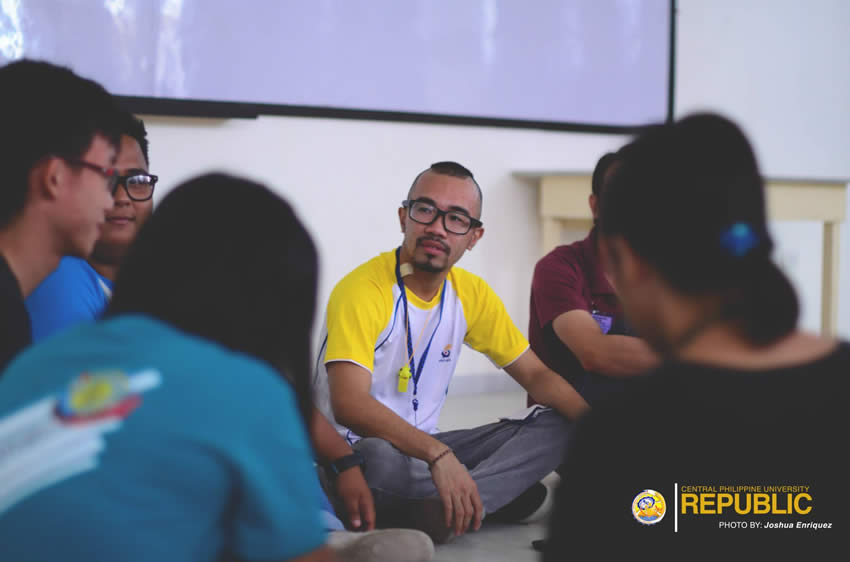
Albert Jan Matthew Java encourages Centralian to be united as the university ushers in a new set of CPUR officials.
Together in sea of tarpaulins and placards, Centralians, with their cheers, filled the Rose Memorial Auditorium with the Central Spirit—the 2019 Central Philippine University Student Republic Election Grand Rally is a spectacle of the supremacy of the student body in the voting process and their involvement in the future programs and initiatives of the next set of CPU Student Republic Officials.
This kind of exhibition has been witnessed by the university for 113 years. Being the oldest student republic in South East Asia, the CPU Student Republic has been an emblem, inspiring young leaders not only to serve Centralians but the community at large.
Throughout the years, the CPUR Elections have been dominated by two student parties—the Reform Party and Koalisyon Party. Both are veteran student institutions celebrating a deep commitment to student leadership and community service.
Koalisyon takes pride in its 35 years of history in the university. According to Albert Jan Matthew Java, CPUR President 2012-2013, Koalisyon’s beginnings started within the CPU College of Theology: “The real name of our party is Koalisyon ng Demokratikong Mag-aaral Para Sa Sambayanan, Our origins are really from the College of Theology. It [was] actually a coalition of two parties. Koa is a pro-student political party that pushes for the rights of the students. It has withstood the Martial Law; it [has] survived throughout the years.”

Java became a part of the Koalisyon Party in 2006 when he ran for Board Member of the CPU High School Student Council. His journey with the party has continued to the time when he became the CPUR President until after his graduation as he mentors the next generation of Koalisyon leaders: “The vision [that has] passed on from generation to generation is that Koalisyon is for the students and by the students. Koalisyon advocates for servant-leadership. Being founded by theology students, Koa dwells on the leadership style of Jesus—which is servant-leadership. In order to be first, you have to be last—you have to serve first before you can lead.”
The Reform Party, on the other hand, was established in 2002. It was formed by five Totoong Partido ng Mag-aaral members, who decided to dissolve TPM and instead organize the Reform Party. According to Jothamme Enriquez, CPUR Senator, 2011-2012, Reform offers a liberal approach in its leadership style: “Ever since I became part of Reform, the party really believed in a more liberal approach [to] student government. We want leaders that are firm in their beliefs but open to new ideas.”
When asked what makes a good CPUR leader, Java highlights the importance of intentions not only in serving the students but in committing oneself to the cause of uplifting and protecting the welfare of Centralians: “For me it’s pure intentions; if you have any other ulterior motive aside from the pure intention of serving the student bod, at the end of the day, when you are stuck with all that you have to do, you will always go back to your motivation and intention. And if there’s just one, slight malice in your motivation, you will get tired of serving. If you have the purest of intentions in serving the students, whatever color you represent, whatever party you come from, whatever course you may be, I tell you, you are right for that position.”
Enriquez, on the other hand, shares that one’s principles are the backbone of serving the studentry: “Principles are important. We need student leaders that disregard the colors of the party and work for the entire studentry—even [for] those who did not vote for them. The moment one wins, the colors you represent don’t matter. I hope you do not forget why you are there in the first place. It’s cliché but it’s all about service and [the] principles you stand for.”
Sharing the challenges that come along with being a CPUR officer, Java and Enriquez agree that it is about handling expectations and implementing their events and advocacies successfully that keep them on their toes. “Just like any other person up in a position, there are always expectations. It’s a challenge because it’s always there but you don’t have to be stressed about it. It’s just a challenge; you can do something about it. At the end of the day, it’s how you manage those expectations and criticisms. You are in control of how you react. You have to react out of love,” Java says.
For Enriquez, the success of every activity depends not only on the CPUR officials. It is the entire student body participating and helping one another that ultimately determines how efficient the CPUR programs and initiatives are: “I hope we help the CPUR Officers because it’s a two-way street. Their activities won’t be as successful if we do not participate. I hope that students will also give credit to their CPUR officers because it’s motivational on their end and encourage them to do more—when [they] see the students enjoying or benefiting from what [they] did, even if [they] just work on the sidelines; when people remember [them] as a student leader serving and giving [their] best for CPU. Being in the CPUR means working behind the scenes most of the time—and it entails a lot of work.”
Emphasizing the Central Spirit, both student leaders share how their fellow CPU alumni mentors help them in their leadership journey. “We have that feeling of interconnected-ness with our alumni and [the alumni] always do what we can to mentor the next generation. We don’t just want to prepare them for the CPUR positions, we want to prepare them for the real world,” Java shares. Enriquez adds, “Until now, we still communicate with our adviser and other fellow alumni who are also part of Reform. We have developed a strong sense of commitment of serving the studentry and along the way, we also gained strong connections and friendships with one another that really embody the Central Spirit.”
As for their message to the Centralian community as the CPUR transitions to new student leadership in the next school year, Java and Enriquez encourage Centralians to be united and set aside party colors. “Let’s forget about the red and the green and go back to the blue and the yellow,” Java urges.
Enriquez also encourages those candidates who did not win to continue serving Central in their own capacity. According to her, the opportunity to serve is not limited in being a CPUR official: “There are so many ways to serve Centralians. You don’t have to be in the CPUR to serve. It’s a wrong notion to believe that you have to be in position to help your fellow Centralians. At the end of the day, yes, the CPUR primarily serves the students but behind the CPUR are also volunteers and willing Centralians, [who] help. The CPUR officers cannot do the task alone.”
As CPU welcomes a new era of student leadership, both the Koalisyon and Reform are united in serving Centralians. At the end of the day it is not the colors they represent during the election but the service and commitment they offer to Centralians for the pride of Central and, most importantly, for the glory of God.


 campus events